Saturday, June 23, 2012

The Lady of Shalott

The re-telling of the story of “The Lady of Shalott,” an Arthurian legend most famously captured in a Tennyson poem. The legend is about a young maiden, trapped by a magic spell in a high tower. She sees the knight Sir Lancelot passing by and she tries to take a boat to Camelot. She drowns on the way and dies.
I love the verse, “The sharp knife/ Of a short life.” This captures two striking aspects of death at a young age and fragility of life. Finally, one quite moving part of this song is “Gather up your tears, keep ‘em in your pocket/ Save them for a time when you’re really gonna need them, oh.” This makes more sense in the video where, at the end, she survives. Clearly, there’s no reason to cry if she’s safe and sound. But I think the line works even if she does die. It is awful to lose a loved one at a young age, but there are much worse tragedies that can affect a person. A slow, painful disease that causes a great deal of suffering for a long time tends to be hard to make peace with than a quick, painless death.

I suppose I would be remiss if I failed to address the spectre of suicide that is lurking in this song. I don’t think the speaker is necessarily suicidal. I think the song works just as well for a young girl who dies of a disease or in an accident. However, if you take the line, “Funny when you’re dead how people start listenin’ ” I have to admit, that sounds an awful lot like suicidal teen crying out for help. There is a notion in that statement that one can express an idea powerfully by the act of dying. But it is tempered by other lines in the song such as “Life ain’t always what you thought it would be” and “I’ve had just enough time.” The overall impression I get is that this young woman is satisfied with the brief spark of life she had.

If I die young bury me in satin
Lay me down on a bed of roses
Sink me in the river at dawn
Send me away with the words of a love song
Oh oh Oh oh

Lord make me a rainbow, I'll shine down on my mother
She'll know I'm safe with you when she stands under my colors, oh and
Life ain't always what you think it ought to be, no
Ain't even gray, but she buries her baby

The sharp knife of a short life, well
I've had just enough time

If I die young bury me in satin
Lay me down on a bed of roses
Sink me in the river at dawn
Send me away with the words of a love song

The sharp knife of a short life, well
I've had just enough time
And I'll be wearing white when I come into your kingdom
I'm as green as the ring on my little cold finger
I've never known the lovin' of a man
But it sure felt nice when he was holding my hand
There's a boy here in town says he'll love me forever
Who would have thought forever could be severed by

The sharp knife of a short life, well
I've had just enough time

So put on your best boys and I'll wear my pearls
What I never did is done

A penny for my thoughts, oh no I'll sell them for a dollar
They're worth so much more after I'm a goner
And maybe then you'll hear the words I been singin'
Funny when you're dead how people start listenin'

If I die young bury me in satin
Lay me down on a bed of roses
Sink me in the river at dawn
Send me away with the words of a love song
Oh oh

The ballad of a dove
Go with peace and love
Gather up your tears, keep 'em in your pocket
Save them for a time when your really gonna need them oh

The sharp knife of a short life, well
I've had just enough time

So put on your best boys and I'll wear my pearls

Slow Life

Monday, June 18, 2012

I hate being locked in a cage, neither stone walls nor iron bars in my whole life

I hate being locked in a cage, neither stone walls nor iron bars in my whole life

Sunday, May 6, 2012

Greensleeve : The Love Letters of Henry VIII to Anne Boleyn


The obsession of King Henry VIII with Anne Boleyn started in 1526.

Greensleeve - Guitar Version

King Henry VIII wrote the following  in an excerpt from a love letter to Anne Boleyn which was written in 1528:
"...having been for more than a year now struck by the dart of love, and being uncertain either of failure or of finding a place in your heart and affection..."
Greensleeve - Piano Version

This King Henry VIII quotation clearly illustrates the unfamiliar position of apparent unrequited love that King Henry had found himself in during his early courtship of Anne Boleyn. King Henry VIII was an extremely accomplished Musician and Composer. Music and the ability to play musical instruments was essential during the Tudor era and the education of King Henry VIII included great attention to the development of musical skills.


First Verse
Alas, my love, you do me wrong,
To cast me off discourteously.
For I have loved you well and long,
Delighting in your company.

Second Verse
So must I meditate alone
Upon your insincerity.

Third Verse
If you intend thus to disdain,
It does the more enrapture me,
And even so, I still remain
A lover in captivity.

Fourth Verse
I have been ready at your hand,
To grant whatever you would crave.

Fifth Verse
Thou couldn't desire no earthly thing,
But still thou hadn't it readily.

 Nineth Verse
My men were clothed all in green,
And they did ever wait on thee;
All this was gallant to be seen,
And yet thou would not love me.

Last Verse
Ah, Greensleeves, now farewell, adieu,
To God I pray to prosper thee,
For I am still thy lover true,
Come once again and love me.


لطفي


Wednesday, April 11, 2012

Greek mythological prophet, Cassandra was a woman cursed with the gift of foretelling the future.


In ancient Greek stories, Cassandra was the daughter of Priam, the King of Troy. The god Apollo gave her the power to see what would happen in the future, but he also made sure that no one would believe her, so when she warned her father that the Greeks could use the Trojan Horse to take control of Troy, no one believed her. Struck by her beauty, Apollo had provided her with the gift of prophecy, but when Cassandra refused Apollo's romantic advances, he placed a curse ensuring that nobody would believe her warnings. Cassandra was then left with the knowledge of future events, but could neither alter these events nor convince others of the validity of her predictions.

Mythology is ripe with tragically sad stories. In fact, very few myths actually finish with a happy ending. However, I consider the story of Cassandra to be one of the very saddest tales of all time. Cassandra was princess of the legendary city of Troy. As was very common in Greek mythology, the god Apollo lusted after the beautiful young mortal woman and intended to make her his own. To convince her to give into his advances, he promised to bestow upon her the gift of prophecy.

While Cassandra was obviously flattered that an Olympian god sought her favors, she wasn't at all convinced that she wanted to take him as lover. Still, unable to resist the gift he offered, she eventually relented.
Apollo took Cassandra under his wing and taught her how to use her prophecies. Once her mentorship was finished, however, Cassandra refused to give her body to Apollo as promised.
Furious at being rejected by a mere mortal Apollo decided to punish her. While he couldn't take back the gift he'd already given, he could alter it. After having his way with Cassandra, the god's anger was still not satiated. So he leveled a terrible curse upon her head. While Cassandra would still be able to foresee the future, the curse ensured that no one would believe her. Worse than that, they would believe that she was purposely telling lies.
True to his word, Cassandra was able to foresee the future for herself and those around her. But every attempt she made to warn people in advance of impending doom was ignored or, worse yet, labeled as an out right lie.
Ashamed of his daughter's supposed madness, the king pronounced her insane and jailed her by locking her inside her own chambers. Denying his daughter altogether, he told many people that she had died. Others, who already knew of her predicament simply didn't care since they, too, thought she was either crazy or a pathological liar.
One of Cassandra's most important prophecies involved the fall of Troy at the hands of the Greeks and the infamous Trojan Horse. Escaping from her prison, she begged her people to believe her predictions but, once again, no one would listen.
Cassandra managed to escape from Troy and elude the raping and pillaging of the Greek's as they tore apart her home. She hid within the temple of the goddess Athena, who promised to provide shelter to her former priestess. But Ajax found the girl there, clinging helplessly to the statue of Athena and he could not resist forcing himself upon the young beauty.
The Cassandra metaphor (variously labelled the Cassandra 'syndrome', 'complex', 'phenomenon', 'predicament', 'dilemma', or 'curse'), is a term applied in situations in which valid warnings or concerns are dismissed or disbelieved.
The goddess, infuriated that such an act would happen in her sacred temple, involving someone under her protection took revenge upon Ajax. She vowed that he would never again return home. Her wrath was fulfilled when Ajax died after his ship crashed against the rocks of Gyraen.
Twice raped, labeled a liar and insane, Cassandra finally relented and gave in to her fate. She allowed Agamemnon to claim her as his concubine, considering herself a rightful spoil of the Trojan War. Although he didn't marry her, she bore him two children, twin boys named Teledamus and Pelops.
Upon return to his home shores, Agamemnon's wife Clytamnestra greeted the couple with full heroic honors. She even embraced Cassandra, promising the young girl that she would make certain her servitude would not be too difficult. However, Cassandra had foreseen her fate as well as that of Agamemnon and she chose to fight it no longer.


The heroine stood her ground outside the castle, waiting until Clytamnestra finished killing her husband and returned to murder Cassandra with the very same ax. Although she knew her children would also die, it is believed that Athena took pity on the hapless mother and blurred that particular part of her prophecy so she didn't have to witness the death of her sons.
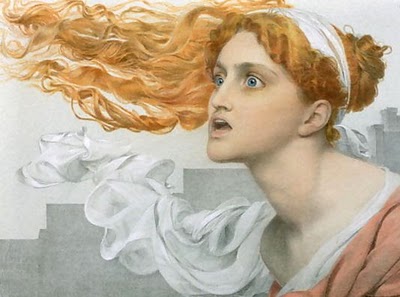
It seems that even history wasn't very kind to the tragic heroine. Most writers condemned her as a madwoman who purposely spouted lies in order to gain attention. Many artists weren't much better, often picturing her with wild, unkept hair and a lunatic expression on her face; barely covered by dress as though she had no morals or sense of propriety.
A few, however, have taken pity on the Cassandra, portraying her more as the lost child that she was. For them, she is often shown on her knees with a helpless look that was meant to garner the pity she so richly deserved. However, she was rarely portrayed, however, as the intelligent heroine that she truly was; a victim of circumstance because she refused to play by the rules established by a group of sanctimonious and undeserving gods.


لطفي


Design by Free WordPress Themes | Bloggerized by Lasantha - Premium Blogger Themes | Best Buy Coupons